
Elbert County Arrest Records and Court Charges
Elbert County arrest records are law-enforcement records. They may involve the arresting agency, booking details, incident report, accident report, body or audio-video material, and jail custody information. The Sheriff's criminal justice records process is the local access channel for sheriff records. The jail phone line is the official route for custody lookup because no official public Elbert County web jail roster was located in the research.
Court charges after arrest are different. A charge record begins when the prosecutor files allegations with the court through a complaint, information, indictment, or related filing. The charge record can show offense name, statute, count number, severity level, filing date, agency, plea, disposition, sentence connection, or dismissal. The full outcome belongs in the Elbert County criminal court records file, while custody and jail status belong with inmate records.
The Sheriff's criminal justice records request page is the official local source for law-enforcement record requests.
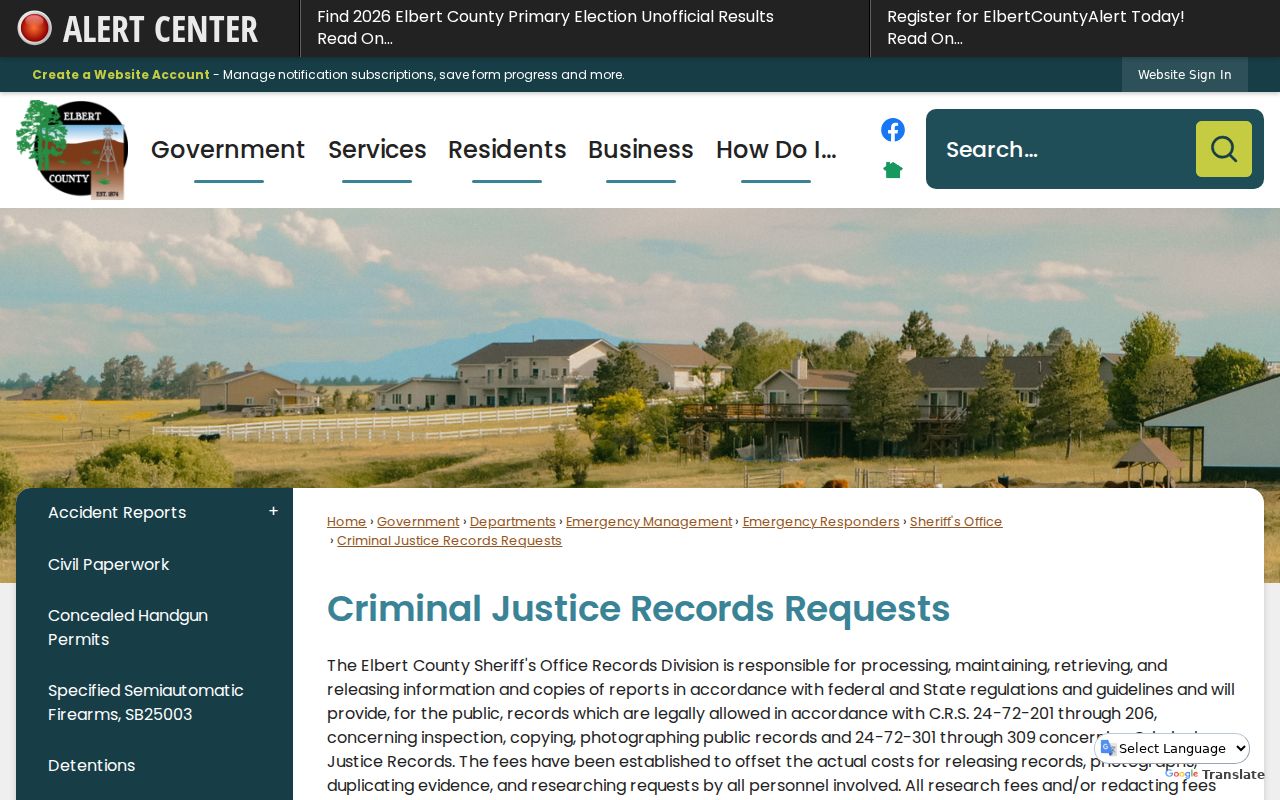
That request channel is for sheriff records, not a substitute for court charge records kept by the Clerk of Court.
Find Elbert County Arrest Records and Charges
Start by identifying the record type. If the question is whether a person is in custody, call the jail information line at 303-621-2027 with the inmate's full name and date of birth if available. If the question is an incident report, accident report, or law-enforcement record, use the Sheriff's records request process. If the question is the formal charge, plea, disposition, or sentence, use the Colorado Judicial Branch docket search, CoCourts, or the Clerk of Court.
- Use sheriff records for incident reports, accident reports, arrest-related law-enforcement files, and body or audio-video items.
- Use jail contact for current custody information because no official public county web roster was located.
- Use court docket search to locate the public court setting, case class, or case number.
- Use CoCourts for paid register-of-actions data where the public criminal case type is covered.
- Ask the Clerk of Court for certified copies or charge documents not visible in public search results.
The Sheriff's page warns that active cases pending court disposition may be referred to the District Attorney's Office for discovery. Discovery is part of the criminal case process. It is not the same as a public-record request, and the requester role can affect what is available.
Charges Filed After an Arrest
After an arrest, the prosecutor reviews the facts and decides what formal charges to file, if any. Elbert County is served by the 23rd Judicial District Attorney for Douglas, Elbert, and Lincoln counties. The Elbert County DA office is at 751 Ute Avenue, PO Box 493, Kiowa, with phone 303-621-2875. The court charge record starts when the charging document enters the court file.
| Document | Filed By | What It Does |
|---|---|---|
| Complaint | Law enforcement or prosecutor, depending on the case path. | Starts or supports a criminal filing and lists the alleged offense. |
| Information | Prosecutor. | States formal charges filed by the District Attorney in court. |
| Indictment | Grand jury. | Charges an offense after grand-jury action in cases where that process is used. |
Colorado County Court handles misdemeanors, traffic offenses, felony complaints that may be sent to District Court, protection orders, small claims, and civil matters under the county-court ceiling. District Court handles felony criminal cases and other general-jurisdiction matters. The court level affects where the charge is filed and how later court events appear.
Elbert County Charge Status
Charge status can change. A charge may begin as one offense and later be amended, reduced, added, dropped, dismissed, or resolved by plea or trial. One arrest can produce several counts, and each count can have a different outcome. CoCourts may show charges, plea, disposition, sentence date, and scheduled events, but the official FAQ warns that criminal cases can represent arrest filings only and may not have been prosecuted by the District Attorney.
| Status | What It Means |
|---|---|
| Pending | The charge is active and has not reached final disposition. |
| Amended or Reduced | The filed allegation changed, often through prosecutor action, plea negotiation, or court order. |
| Dismissed | The charge was ended by the court or prosecution and did not result in conviction on that count. |
| Dropped | The prosecution did not continue with that charge, though the record may still show prior filing activity. |
| Disposed | The charge has a recorded outcome, such as guilty, dismissed, deferred, or another final entry. |
Note: A charge appearing in a public case index is not proof that the person was convicted.
Elbert County Charges vs Convictions
The difference between a filed charge and a conviction is the most important reading rule for arrest records and court charges after arrest. A charge is an accusation. A conviction is a court outcome. An arrest can lead to no charge, one charge, several charges, a reduced charge, a dismissal, or a conviction. That is why charge lists should be read with plea, disposition, and sentence fields.
| Point | Charge | Conviction |
|---|---|---|
| Meaning | Formal allegation filed or listed in the court case. | Guilty finding, guilty plea, or qualifying resolved result. |
| Timing | Appears before the final outcome. | Appears after plea, verdict, or disposition. |
| Status Risk | May be pending, amended, reduced, or dismissed. | May lead to sentence, probation, fines, costs, or restitution. |
| Record Source | Charging document, docket, register of actions, or court index. | Disposition entry, sentencing order, or final case record. |
Public Access to Arrest and Charge Records
Colorado uses different rules for different custodians. Court charge records follow Judicial Branch access rules, including Chief Justice Directive 05-01 and P.A.I.R.R. Sheriff's criminal justice records follow C.R.S. 24-72-301 through 309, the Colorado Criminal Justice Records Act. County administrative records use CORA, C.R.S. 24-72-201 through 206. A request for an arrest report should not be sent to the same place as a request for a certified court charge document unless the custodian is the same.
The Colorado Attorney General's CORA and CCJRA explanation provides statewide context for public records and criminal justice records.
That state-level explanation helps distinguish ordinary public records from criminal justice records subject to custodian review.
Statewide Charge and Custody Lookups
Statewide searches answer different questions. The Colorado Department of Corrections offender search concerns state-prison custody, not the Elbert County jail and not a county court charge list. The court's docket and CoCourts tools are better for public court charges. The Sheriff's Office is better for local arrest reports and custody-related sheriff records. The Clerk of Court is better for charge documents and certified case copies.
The Colorado DOC offender search is relevant only when the person is in state prison or DOC custody.
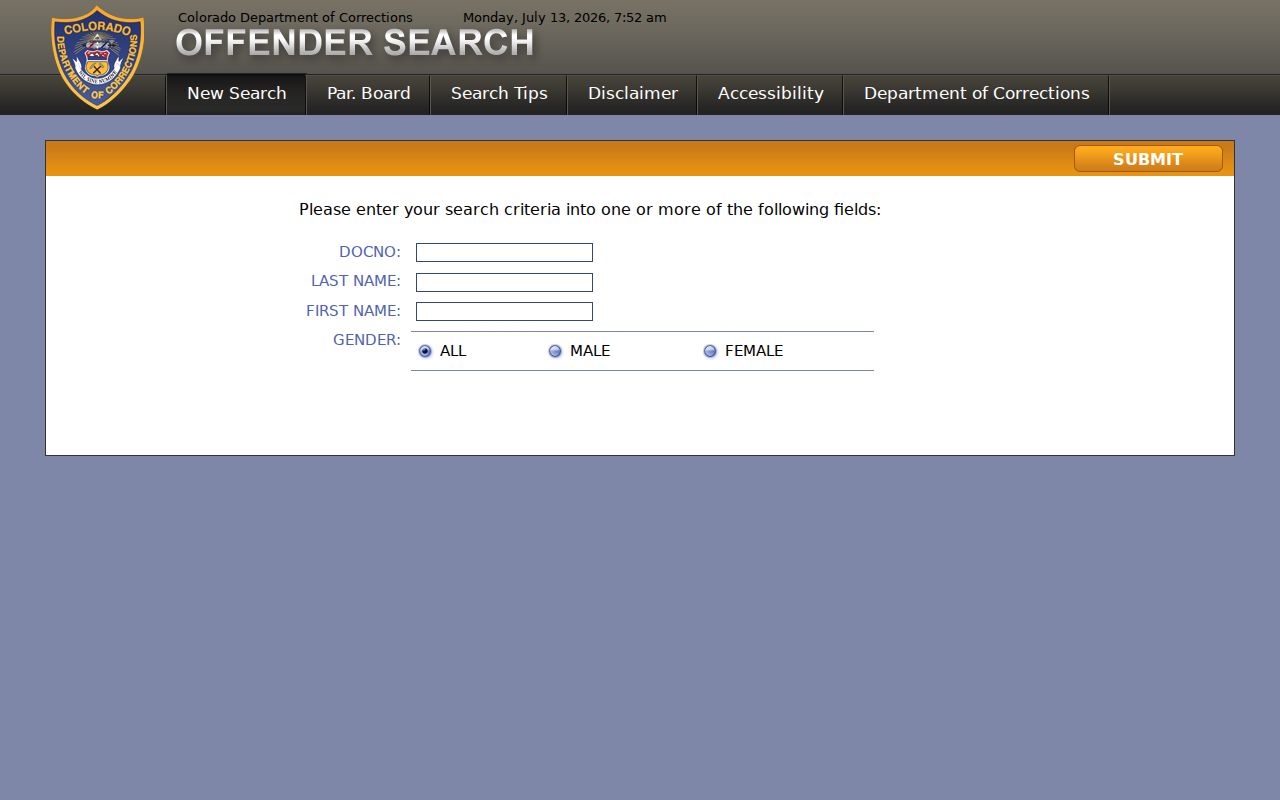
A DOC result should not be treated as a county arrest record or as the court's charge-by-charge disposition.
Sealed Arrest and Charge Records
Colorado sealing can apply to arrest, nonconviction, and conviction records when statutory criteria are met. CBI and Judicial Branch materials route sealing questions to C.R.S. 24-72-703 through 24-72-710, including C.R.S. 24-72-705 for criminal justice records other than convictions and C.R.S. 24-72-706 for conviction records. A person may need current Judicial Branch forms, a verified criminal history, a custodian list, and filing in the court that handled the case.
| Point | Sealed | Expunged |
|---|---|---|
| Public Access | Restricted from ordinary public view after the correct process. | Removed or destroyed only where a specific law allows that result. |
| Common Use | Adult arrest, nonconviction, and eligible conviction records. | Limited categories, often with special statutory rules. |
| Still Visible To | May remain visible to courts, law enforcement, or licensing entities. | Depends on the order and statute. |
| Where Filed | Usually in the court that handled the charge or case. | Depends on the case type and Colorado law. |
Charge Codes and Severity Levels
Charge records can include offense names, statutes, count numbers, and classifications. The docket search case class can help identify the file type, such as CR for criminal, M for misdemeanor, T for traffic, or other Colorado case classes visible in the statewide docket form. The offense class affects court path, possible sentence, and public access, but a code alone is not enough. Always read the charge status, plea, disposition, and sentence fields together.
Traffic offenses may appear in County Court or municipal court depending on the ticket. A criminal traffic charge such as DUI or DWAI should be treated as a criminal court matter for court-record reading, while DMV points and license status are held by the Colorado DMV. A municipal ordinance matter may require contact with Elizabeth, Kiowa, or Simla rather than the state court portal.
Background Check Limits
Arrest records and court charges after arrest can be incomplete if read outside their legal context. A sheriff record may show an arrest event. A court index may show a filed charge. A criminal court record may show the final disposition. A statewide custody search may show prison status. None of those should be merged into a screening report unless the process complies with the laws that govern that use.
Important: This information is not an FCRA consumer report and cannot be used for employment, tenant, credit, or insurance screening.
Restricted Charge Records in Elbert County
Juvenile charges, sealed charges, suppressed filings, confidential filings, victim information, protected addresses, police officer information, juror data, Social Security numbers, and street addresses may be restricted or redacted. Public users may see no result even when a restricted charge record exists. Active cases can also be limited by discovery rules, especially when evidence, reports, or body and audio-video items are requested.
Use the correct contact for each record. Sheriff's records requests may be submitted in person at 751 Ute Avenue, by mail to PO Box 486, or by email to sorecords@elbertcounty-co.gov. Court charge copies route to the Clerk of Court at 303-621-2131 or elbertresearch@judicial.state.co.us. DA discovery questions route to the 23rd Judicial District Attorney, and defense eligibility questions route to the Colorado State Public Defender Douglas office.